







The Last Letter from Willow Creek is An Original Short Story by John DeRossett The letter arrived on a Tuesday, thirty-seven years after it had been written. There was nothing particularly remarkable about the envelope. It was yellowed around the edges, the paper brittle, and the handwriting across the front belonged to a time when […]
The Last Letter from Willow Creek is An Original Short Story by John DeRossett
The letter arrived on a Tuesday, thirty-seven years after it had been written.
There was nothing particularly remarkable about the envelope. It was yellowed around the edges, the paper brittle, and the handwriting across the front belonged to a time when people still believed a letter deserved their very best penmanship.
What made it remarkable was the return address.
Willow Creek, West Virginia.
And the name beneath it.
Thomas Whitaker.
Daniel Whitaker stood at his kitchen counter, staring at the envelope while the coffee maker sputtered behind him.
His father had been dead for thirty-six years.
For a long moment, Daniel considered the possibility that someone was playing a particularly cruel joke. But the handwriting was unmistakable. He had seen it on birthday cards, Christmas presents, permission slips, and the occasional note left on the refrigerator.
He turned the envelope over.
The flap was still sealed.
A small red stamp in the corner read:
UNDELIVERABLE — HELD FOR ADDRESS VERIFICATION
Below it, someone had written in blue ink:
Found during closure of Willow Creek Post Office. Forwarded to last known address.
Daniel pulled out a chair and sat down.
He was sixty-two years old. He had buried both parents, survived a divorce, raised two children who now had children of their own, and spent forty years convincing himself that the past was something best left undisturbed.
Yet here it was, sitting on his kitchen table.
A letter from a dead man.
And he was afraid to open it.
Willow Creek was the sort of town that appeared on maps only because someone at the state highway department had once decided it deserved a name.
There was a church with a crooked steeple, a volunteer fire department, a general store that sold everything from fishing worms to aspirin, and a collection of houses scattered along a narrow valley where the mountains seemed to lean toward one another.
The creek itself ran behind the school, under the railroad bridge, and eventually disappeared into a larger river several miles downstream.
Daniel had grown up there.
His father worked for the railroad. His mother taught third grade. Their house stood at the end of Maple Street, a two-story white frame building with a wraparound porch and a stubborn maple tree that dropped leaves well into December.
His childhood had been ordinary in the way that childhoods often seemed ordinary until you grew old enough to recognize what had been extraordinary about them.
Summer evenings on the porch.
His mother’s biscuits.
The sound of coal trains passing through town after midnight.
And his father.
Thomas Whitaker was not an affectionate man.
He wasn’t cruel, either. He simply belonged to a generation of men who measured love in hours worked, bills paid, and roofs repaired before winter.
He rarely said I love you.
Instead, he checked Daniel’s tires before a long trip.
He filled the woodbox without being asked.
He slipped twenty-dollar bills into his son’s coat pocket when he thought nobody was looking.
Daniel had understood none of that at seventeen.
At seventeen, all he understood was that he wanted out.
He wanted cities, noise, opportunity, and a life that didn’t involve working on the railroad or spending his Saturdays mowing the same yard his father had mowed for twenty years.
His father wanted him to stay.
That was where the trouble began.
The argument happened on an August evening in 1988.
Daniel remembered the heat more than anything else. The windows were open, but no breeze moved through the house. Cicadas screamed from the trees, and somewhere down the street, a dog barked at passing cars.
He had received an acceptance letter from a technical school in Pittsburgh.
His mother was delighted.
His father was not.
“There’s good work right here,” Thomas said, folding the newspaper and setting it beside his plate.
“There’s work,” Daniel answered. “That doesn’t mean it’s good.”
His father’s jaw tightened.
“That railroad put food on this table.”
“I know, Dad.”
“Put clothes on your back.”
“I know.”
“Paid for that car you’re driving.”
Daniel sighed.
“That’s not what I’m saying.”
“Then what are you saying?”
“I’m saying I don’t want your life.”
The words landed harder than Daniel intended.
His mother stopped washing dishes.
Thomas stared at his son for several seconds.
Then he nodded.
“Well,” he said quietly, “I suppose that makes two of us.”
Daniel stood.
“What does that mean?”
“Means you don’t know half as much as you think you do.”
“And you don’t know anything about what I want.”
His father pushed back his chair.
“I know what it takes to make a living.”
“And I know I don’t want to spend forty years in this town waiting to die.”
The silence that followed seemed to swallow every sound in the house.
Thomas looked toward the kitchen window.
“Then go,” he said.
Daniel grabbed his car keys.
“Maybe I will.”
“Maybe you should.”
He left that night.
His mother called two days later to tell him his father had been asking about him.
Daniel refused to call.
His father refused to call.
Both men were stubborn.
Neither understood how little time they had.
Thomas Whitaker died the following spring.
A massive heart attack.
He was fifty-eight.
Daniel received the news while working an overnight shift at a Pittsburgh warehouse.
By the time he reached Willow Creek, the funeral arrangements had already been made.
His mother met him at the front door.
She looked smaller than he remembered.
“He was proud of you,” she said.
Daniel couldn’t answer.
“He talked about you all the time.”
“Mom—”
“He just didn’t know how to tell you.”
Daniel looked past her into the familiar living room.
His father’s chair sat beside the window.
A folded newspaper rested on the arm.
For one impossible second, Daniel expected him to walk through the kitchen door.
He never did.
At the funeral, people told stories.
How Thomas had repaired a neighbor’s furnace during a blizzard.
How he’d paid for groceries when a young family came up short.
How he’d spent three weekends helping rebuild the church steps.
Daniel listened and wondered why the man everyone described seemed so different from the father he remembered.
After the service, he stood beside the grave until everyone else had gone.
He wanted to say something.
An apology, perhaps.
Or an explanation.
Instead, he whispered, “I didn’t mean it.”
The wind moved through the cemetery.
There was no answer.
Thirty-seven years later, the envelope waited on Daniel’s kitchen table.
He made another cup of coffee.
Then another.
Finally, he slipped a butter knife beneath the flap and opened it.
Inside were three pages of lined notebook paper.
The handwriting was careful but uneven, as though the writer had stopped frequently to consider his words.
Daniel unfolded the first page.
Dear Danny,
Nobody had called him Danny in decades.
I reckon this letter is going to surprise you. Truth is, writing it surprises me. Your mother says I ought to pick up the telephone, but you know me. I’ve never been much good at talking about things that matter.
Daniel swallowed.
I’ve been thinking about what you said that night.
About not wanting my life.
At first, I was angry. I won’t lie about that. I worked hard to give you a good home, and hearing you say you wanted no part of it hurt more than I cared to admit.
But I’ve had time to think.
And I believe I owe you an apology.
Daniel stopped reading.
Outside, a delivery truck rolled down the street.
A lawn mower started somewhere nearby.
The ordinary world continued, entirely unaware that something inside him had shifted.
He read on.
You see, Danny, when I was your age, I wanted to leave Willow Creek, too.
I wanted to be a photographer.
Daniel frowned.
A photographer?
His father had never owned a camera beyond the cheap Kodak he brought out at Christmas.
I used to take pictures of everything. Trains, mountains, old buildings, people sitting on their porches. I saved enough money to buy a good camera from a fellow in Charleston, and I thought maybe I could make something of it.
Then your grandfather got sick.
The railroad offered me a job. Your grandmother needed help. I told myself I’d work a year or two and then go chase my dream.
One year became five.
Five became twenty.
And somewhere along the way, I quit thinking about photographs.
Daniel lowered the letter.
He tried to picture his father as a young man with a camera hanging around his neck.
He couldn’t.
The image simply didn’t fit the man he knew.
I’m not telling you this because I regret my life. I married your mother. We had you. Those are the two best things that ever happened to me.
But I do regret letting you think that because I stayed, you had to stay, too.
I reckon I was afraid.
Afraid you’d leave and never come back.
Afraid there wouldn’t be anything here worth returning for.
And maybe, if I’m being truthful, I was a little jealous that you had the courage to do what I never did.
Daniel wiped his eyes with the back of his hand.
He hadn’t realized he was crying.
So here’s what I want you to know.
Go to Pittsburgh.
Learn everything you can.
Make a life that belongs to you.
And don’t ever mistake leaving home for leaving the people who love you.
No matter where you go, you’ll always have a place here.
The last paragraph was written more slowly, the letters larger.
I love you, son.
I should have said that more often.
Your dad,
Thomas Whitaker
Daniel sat motionless.
Then he turned the page over.
There was a postscript.
P.S. If you ever want to see those old photographs, they’re in a wooden box in the attic. Your mother knows where.
His mother had been gone for eleven years.
The house on Maple Street had been sold long before that.
Daniel had returned to Willow Creek only a handful of times since the funeral, mostly to visit his mother after she moved into a nursing home in Morgantown.
He hadn’t driven through town in nearly twenty years.
He opened his laptop and searched for the old address.
The house was still there.
A real estate photograph showed fresh blue shutters, a new metal roof, and the same stubborn maple tree in the front yard.
He enlarged the image.
The porch had been enclosed.
The garden was gone.
But the house was unmistakably home.
Daniel stared at the screen.
Then he searched for Willow Creek.
The post office had closed six months earlier.
The school was gone.
The general store had become a vacant lot.
Even the railroad had stopped running regular freight through the valley.
Time had been busy.
He found a community page online.
Most posts concerned lost dogs, road repairs, church dinners, and arguments over whether the county should repair the old railroad bridge.
He scrolled until a photograph caught his attention.
It showed a group of people standing outside the volunteer fire department.
One of them was a woman named Margaret Bell.
Daniel remembered her.
Maggie Bell.
She had been two years behind him in school, with red hair, freckles, and an unfortunate habit of correcting teachers when they made mistakes.
According to the post, she now served as president of the Willow Creek Historical Society.
Daniel laughed softly.
Of course she did.
He sent her a message.
Margaret, this is Daniel Whitaker. Thomas Whitaker’s son. I grew up on Maple Street. I have a strange question about some old photographs my father may have left behind.
Her reply arrived eleven minutes later.
Danny Whitaker? Well, I’ll be damned.
Call me.
Maggie answered on the second ring.
“Daniel Whitaker,” she said. “I thought you fell off the face of the earth.”
“Just Pittsburgh.”
“Same difference.”
He laughed.
Her voice had changed, but not much. It still carried the brisk certainty he remembered from school.
They spent twenty minutes catching up.
Maggie had married, divorced, raised three children, and retired from teaching. She had returned to Willow Creek after her mother died and discovered, to her surprise, that she liked the place better than she had at eighteen.
Then Daniel told her about the letter.
When he finished, Maggie was quiet.
“I remember your dad,” she said.
“Everybody seems to remember a different version of him than I do.”
“That’s how fathers work sometimes.”
“He wrote about being a photographer.”
“Oh, honey.”
“What?”
“You really didn’t know?”
“Know what?”
Maggie sighed.
“Your father took pictures of practically everybody in Willow Creek. Weddings, birthday parties, church picnics, baseball games. He used to develop them in a little room behind your grandfather’s garage.”
Daniel closed his eyes.
“Nobody ever told me.”
“Well, I suppose everybody figured you knew.”
He looked again at the letter.
“Do you know what happened to his photographs?”
“Some of them are in the historical society collection.”
Daniel sat forward.
“What?”
“We’ve got maybe forty or fifty prints with his name on the back. Your mother donated them years ago.”
“And the others?”
“I don’t know.”
He glanced toward the photograph of his childhood home on the laptop.
“What about the people living in our old house?”
“Nice couple. The Hendersons. They’ve been there about eight years.”
“Do you think they’d let me look in the attic?”
Maggie paused.
“There’s only one way to find out.”
Daniel left Pittsburgh on Friday morning.
He told his daughter he was taking a weekend trip.
“Where?” she asked.
“Home.”
She sounded puzzled.
“Dad, you are home.”
He looked around his kitchen.
The stainless-steel appliances.
The spotless countertops.
The framed photographs of his grandchildren.
She wasn’t wrong.
But neither was he.
“Just somewhere I haven’t been in a while,” he said.
The drive took a little over two hours.
As the interstate gave way to two-lane roads, the landscape changed.
Buildings grew farther apart.
The mountains rose closer.
Small towns appeared around bends and vanished just as quickly.
Daniel passed an abandoned gas station, a weathered barn, and a church whose sign promised that God was still accepting applications.
He smiled.
Some things never changed.
Then he rounded a familiar curve and saw the valley.
Willow Creek lay beneath him, a scattering of rooftops tucked between wooded hills.
For a moment, he was seventeen again.
Driving too fast.
Radio turned up.
Certain that every important thing in life existed somewhere beyond those mountains.
He pulled onto the shoulder.
Turned off the engine.
And cried.
Not the quiet tears he’d shed while reading his father’s letter.
These came from somewhere deeper.
From the boy who had left.
From the man who had stayed away.
From thirty-seven years of words never spoken.
When he finally drove into town, the church bell was ringing noon.
Maggie met him outside the historical society building, which occupied the former bank.
She was shorter than he remembered, her red hair now mostly silver.
But her smile was the same.
“Look at you,” she said, hugging him.
“Look at you.”
“Don’t start.”
Inside, the building smelled of old paper and furniture polish.
Display cases held railroad lanterns, school photographs, military uniforms, and faded newspaper clippings.
On one wall hung a large black-and-white photograph of Willow Creek in winter.
Daniel recognized the view immediately.
The railroad bridge.
The creek.
Smoke rising from chimneys.
He stepped closer.
A small plaque beneath it read:
Willow Creek, January 1964
Photograph by Thomas Whitaker
Daniel touched the edge of the frame.
“My father took this?”
Maggie nodded.
“He had an eye for things.”
The photograph was beautiful.
Not because Willow Creek had been beautiful in any conventional sense. The buildings were worn, the streets muddy, and the railroad tracks cut an ugly line through the valley.
But the image captured something Daniel couldn’t name.
A stillness.
A kind of dignity.
The sense that ordinary places mattered because ordinary lives unfolded within them.
He stood before it for several minutes.
Then Maggie led him to a table covered with archival folders.
“These are the ones we’ve got.”
She opened the first.
A little girl standing beside a birthday cake.
Two railroad workers leaning against a locomotive.
A woman hanging laundry in the summer sunshine.
A group of boys fishing from the bridge.
Daniel turned each photograph carefully.
There were names on the backs.
Dates.
Sometimes brief descriptions.
His father’s handwriting.
In one photograph, a young woman stood in a garden, holding a baby.
Daniel recognized her instantly.
His mother.
And the baby—
“That’s me.”
Maggie smiled.
“Sure is.”
He stared at the photograph.
His mother couldn’t have been more than twenty-five.
She was laughing.
Not posing.
Not looking at the camera.
Simply laughing at something beyond the frame.
Daniel had never seen the photograph before.
“Can I get a copy?”
“Of course.”
He hesitated.
“Maggie, do you think my father was any good?”
She looked genuinely surprised.
“Daniel, your father was one of the best photographers this county ever produced.”
He looked down at the pictures.
“Then why didn’t he do more with it?”
“Life,” she said.
It was a small word.
It seemed to explain everything.
The Hendersons lived in the house on Maple Street with two cats and an enormous golden retriever named Charlie.
They were gracious about Daniel’s unexpected request.
“We’ve never really gone through the attic,” Mrs. Henderson explained. “There’s some old furniture and boxes up there from before we bought the place.”
Daniel followed Mr. Henderson up the narrow stairs.
The attic smelled exactly as he remembered.
Dust.
Old wood.
The faint sweetness of insulation warmed by the afternoon sun.
Light entered through a small window at the far end.
Daniel remembered hiding there as a boy, reading comic books when he was supposed to be doing chores.
The space seemed smaller now.
Everything did.
They searched for nearly an hour.
There were Christmas decorations, broken lamps, an old sewing machine, and a collection of empty mason jars.
No wooden box.
Daniel tried not to show his disappointment.
“Maybe somebody threw it away,” Mr. Henderson said apologetically.
“Maybe.”
They were preparing to leave when Daniel noticed a narrow opening behind the chimney.
A loose board covered part of it.
He knelt.
Pulled the board aside.
And saw a corner of dark wood.
“Wait.”
He reached into the space.
Dust rose around his arm.
His fingers closed around a handle.
He pulled.
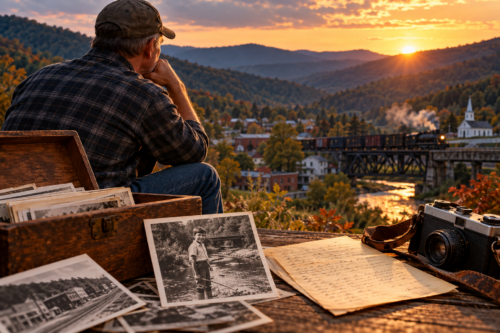
A small wooden chest emerged from the darkness.
The brass hinges were tarnished.
A faded railroad sticker clung to the lid.
Daniel knew the box.
He had seen it beneath his father’s workbench when he was a child.
He simply hadn’t known what it contained.
For a moment, he couldn’t move.
Then he opened it.
Inside were dozens of envelopes filled with photographs.
A leather camera strap.
Several rolls of undeveloped film.
A notebook.
And a small black camera wrapped in a dish towel.
Daniel lifted it carefully.
The metal was cool against his hands.
He turned it over.
Scratched into the bottom were two initials.
T.W.
His father’s camera.
The one he’d never known existed.
Daniel spent the next three days in Willow Creek.
He rented a room above the diner, where the owner insisted he looked just like his father.
He walked streets that had once seemed endless.
He visited the cemetery.
And he spent hours sorting photographs with Maggie.
The notebook proved especially remarkable.
His father had kept detailed records of nearly every photograph he’d taken.
Names.
Dates.
Locations.
Sometimes personal observations.
Mrs. Parker, age 91. Still makes her own bread.
Jimmy Collins leaving for the Army. Mother cried after picture.
First snowfall. Creek nearly frozen.
One entry caught Daniel’s attention.
August 12, 1988. Danny left for Pittsburgh.
Below it, his father had written:
House feels empty.
Daniel turned the page.
August 19. Evelyn says I should call him. She’s right.
Another page.
September 3. Wrote Danny a letter. Need to mail it.
Daniel stopped.
The letter.
His father had written it months before he died.
Why hadn’t it arrived?
He checked the envelope again.
The original address was correct.
The postage was valid.
There was a postmark from September 1988.
Maggie examined it.
“Maybe it got lost in the old sorting room,” she said. “That post office had boxes of undelivered mail when they closed it.”
Daniel nodded.
Thirty-seven years.
A letter had spent thirty-seven years waiting to be delivered.
And during those years, he’d built an entire understanding of his father around a silence that hadn’t been intentional.
He looked at the notebook.
At the camera.
At the photographs.
“There’s something I want to do,” he said.
The idea began simply.
An exhibition of Thomas Whitaker’s photographs at the historical society.
Maggie loved it.
The board approved it.
Word spread through town.
People began arriving with pictures they’d kept in drawers, albums, and shoeboxes for decades.
A wedding photograph from 1962.
A high school graduation.
A family reunion.
A little boy standing proudly beside his first bicycle.
All photographed by Thomas Whitaker.
Each picture told a story.
And every story revealed another piece of the man Daniel had thought he knew.
Mrs. Collins, now ninety-four, arrived with a photograph of her late husband standing outside the railroad depot.
“Your daddy took this the day Harold retired,” she said.
Daniel studied the image.
“He looks happy.”
“He was.”
She touched the photograph.
“Your father wouldn’t take a dime for it.”
Another woman brought a picture of her parents on their wedding day.
A retired firefighter contributed photographs from a flood in the early seventies.
A man Daniel barely remembered arrived with a battered envelope containing a photograph of his brother, who had died in Vietnam.
“Your dad took this before Bobby shipped out,” the man said.
He looked at Daniel.
“It’s the best picture we ever had of him.”
By the end of the week, the collection had grown to more than two hundred photographs.
Daniel realized something that would have astonished his seventeen-year-old self.
His father had been an artist.
Not a famous one.
Not a wealthy one.
Not even a man who called himself an artist.
But an artist nonetheless.
He had spent a lifetime preserving moments that otherwise would have disappeared.
And he’d done it quietly, between shifts at the railroad, without recognition or reward.
The exhibition opened on a Saturday in October.
The leaves had turned brilliant shades of red and gold.
A cool wind moved through the valley.
The historical society expected perhaps thirty visitors.
More than a hundred came.
Some traveled from neighboring towns.
Others drove from Pennsylvania, Ohio, and Maryland after hearing about the exhibition online.
The photographs filled three rooms.
Each had been cleaned, scanned, and carefully labeled.
A large portrait of Thomas Whitaker hung near the entrance.
Daniel had found it in the wooden box.
His father was young, perhaps twenty-five, standing beside a railroad locomotive with a camera hanging from his neck.
He was smiling.
Not the restrained, polite smile Daniel remembered from family photographs.
A broad, unguarded smile.
The face of a man who believed the world still held possibilities.
Daniel stood beside the portrait as visitors arrived.
They shook his hand.
Shared memories.
Told stories.
Some made him laugh.
Others left him struggling for words.
Then a little girl approached.
She couldn’t have been more than ten.
She pointed toward a photograph of an old woman sitting on a porch.
“That’s my great-grandma.”
Daniel crouched beside her.
“Is it?”
She nodded.
“Mom says she died before I was born.”
He looked at the photograph.
The woman held a cup of coffee in one hand and a small dog in her lap.
She was smiling directly at the camera.
“She looks happy,” Daniel said.
The girl studied the picture.
“She does.”
Then she looked at him.
“Did your dad know her?”
“I think he did.”
“Then I’m glad he took her picture.”
Daniel felt something tighten in his throat.
“So am I.”
Late that afternoon, Maggie found him sitting alone in the back room.
The crowd had thinned.
Volunteers were stacking chairs and gathering empty coffee cups.
“You all right?” she asked.
Daniel nodded.
“Just thinking.”
“About your dad?”
“About how much time I wasted being angry with him.”
Maggie sat beside him.
“You were a kid.”
“I was seventeen.”
“Exactly.”
He looked toward the doorway.
“I spent thirty-seven years believing he died disappointed in me.”
Maggie said nothing.
“And all that time, he had written me a letter saying the opposite.”
“Daniel.”
He looked at her.
“You can’t change the years,” she said. “But you can change what you do with the ones you’ve got left.”
He smiled faintly.
“That sounds like something you’d put on a classroom wall.”
“I probably did.”
They laughed.
Then Maggie reached into her purse.
“There’s one more thing.”
She handed him a small envelope.
“Mrs. Henderson found it inside the lining of the wooden box. She brought it over this morning.”
Daniel opened it.
Inside was a single photograph.
A boy of about twelve stood beside the creek, holding a fishing rod.
His hair was messy.
His jeans were rolled above his ankles.
He wore a grin that seemed far too large for his face.
Daniel recognized himself.
On the back, his father had written:
Danny. Summer 1983.
Below that was another line.
He doesn’t know it yet, but he’s going places.
Daniel stared at the words.
He had spent most of his adult life remembering the argument.
Remembering his father’s anger.
Remembering the words Then go.
He had forgotten the fishing trips.
The Saturday mornings.
The way his father stood in the rain watching his baseball games.
The quiet pride in his eyes when Daniel brought home a good report card.
He had mistaken one terrible evening for an entire relationship.
And now, nearly four decades later, his father had given him something he hadn’t known he needed.
Permission to remember the good.
Daniel returned to Pittsburgh on Sunday.
The wooden box rode in the passenger seat.
He stopped twice along the way, once for coffee and once at a scenic overlook where the mountains stretched toward the horizon.
At the overlook, he took out his father’s camera.
It was old and heavy.
The leather strap was cracked.
He doubted it still worked.
But he lifted it to his eye anyway.
Through the viewfinder, the mountains appeared framed in a small rectangle.
He adjusted the focus.
For a moment, he imagined his father standing in the same place, searching for the right angle, waiting for the light.
Then he lowered the camera.
He understood something now.
His father hadn’t stopped being a photographer when he took the railroad job.
He had simply stopped believing it could become his profession.
But he never stopped seeing the world through a photographer’s eyes.
And perhaps that was why he’d taken so many pictures of ordinary people doing ordinary things.
He knew those moments mattered.
He knew they wouldn’t last.
Daniel carefully returned the camera to its case.
Then he took out his phone and called his daughter.
She answered after several rings.
“Hey, Dad.”
“Hey, sweetheart.”
“How was your trip?”
“Good. Really good.”
“Find what you were looking for?”
He looked out across the mountains.
“I think so.”
They talked for a while.
About her job.
About the grandchildren.
About the weather.
Then Daniel said, “Listen, there’s something I want to tell you.”
“What?”
He hesitated.
It shouldn’t have been difficult.
Three simple words.
Words his father had struggled to say.
Words Daniel had sometimes assumed his own children understood without hearing.
“I love you.”
His daughter laughed softly.
“I love you too, Dad.”
“I know. I just wanted to say it.”
There was a pause.
“Everything okay?”
“Everything’s fine.”
He smiled.
“Better than fine.”
That winter, Daniel began writing.
At first, he intended only to record the stories people had shared during the exhibition.
But the project grew.
He wrote about Willow Creek.
About the railroad.
About his mother.
About the house on Maple Street.
And about a father who had spent his life expressing love in ways his son hadn’t known how to recognize.
He titled the manuscript The Things We Leave Behind.
When he finished the first chapter, he printed it and placed it inside the wooden box beside his father’s photographs.
He wasn’t certain whether anyone would ever publish it.
That didn’t matter.
Some stories deserved to be told whether the world was listening or not.
On the anniversary of his father’s death, Daniel returned to Willow Creek.
The cemetery was quiet.
Spring flowers had begun pushing through the earth.
He knelt beside the headstone and brushed away a few fallen leaves.
“Hey, Dad.”
He sat on the grass.
“I got your letter.”
The wind moved gently through the trees.
“Took a while.”
He laughed.
Then he reached into his coat and removed a photograph.
It showed three generations of Whitakers.
Daniel.
His daughter.
And his grandson, a boy with his father’s dark eyes and stubborn chin.
They stood together on a sunny afternoon, smiling at the camera.
Daniel placed the photograph against the headstone.
“I think you’d like him,” he said. “He’s got a little of you in him.”
He stayed for a long time.
Talking.
Remembering.
Saying things he should have said years earlier.
Finally, he stood.
“I love you, Dad.”
He started toward his car, then stopped and looked back.
For most of his life, he’d believed that forgiveness required two people.
An apology offered.
An apology accepted.
A conversation.
An understanding.
But sometimes, he realized, forgiveness arrived in an old envelope.
Sometimes it waited in a dusty attic.
Sometimes it came through the kindness of strangers who remembered a man differently than his own son had.
And sometimes it began with the simple realization that the people we love are human.
Imperfect.
Afraid.
Trying.
He walked to his car.
Before getting in, he looked once more toward the cemetery.
The afternoon sun fell across the headstones.
Beyond them, the mountains rose green against the spring sky.
Somewhere in the valley, a train whistle sounded.
Daniel smiled.
For the first time in thirty-seven years, he no longer felt that he had left Willow Creek behind.
He had simply taken the long way home.
THE END