
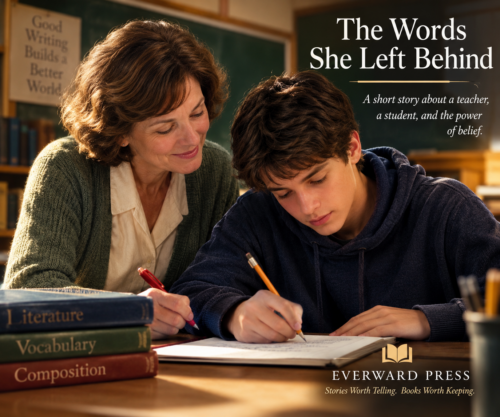
A Short Story by John DeRossett
He was fourteen years old when he first walked into her ninth-grade English classroom.
He wasn’t particularly popular, wasn’t an athlete, and certainly wasn’t the sort of student anyone expected to accomplish anything extraordinary.
But he liked words.
He liked the way they sounded, the way they could paint pictures in someone’s mind, and the way a person could arrange them into something that hadn’t existed a moment before.
His teacher noticed.
Mrs. Martin wasn’t the kind of teacher who needed to raise her voice to command a classroom. She had a way of making students want to do their best, even when they weren’t entirely convinced they had a best to give.
One afternoon, she stopped him as he was leaving class.
“Have you ever thought about entering the spelling bee?”
He looked at her, puzzled.
“Me?”
“Yes, you.”
“I don’t know. I’m not that good.”
She smiled.
“Well, I think you might surprise yourself.”
And so began several weeks of studying words he could barely pronounce, much less spell.
Mrs. Martin worked with him, correcting his mistakes, encouraging him when he stumbled, and reminding him that knowing every word wasn’t nearly as important as having the courage to try.
When the school spelling bee arrived, he was nervous.
One by one, the other contestants were eliminated.
Then there were two.
Then there was one.
Him.
He had won.
Mrs. Martin seemed every bit as pleased as he was.
The victory earned him a place in the county spelling bee, where he would compete against students from other schools.
He studied harder than ever.
But the county competition didn’t end the same way.
He missed a word.
Just one word.
And suddenly, it was over.
He returned to school disappointed, feeling as though he’d let his teacher down.
Mrs. Martin didn’t see it that way.
“You won your school’s spelling bee,” she reminded him. “That’s something to be proud of.”
“But I lost.”
“You didn’t lose everything you learned getting there.”
He never forgot that.
Yet the spelling bee wasn’t the most important thing she gave him.
It was what happened afterward.
Throughout the school year, she assigned essays. Sometimes the topics were ordinary, sometimes they required imagination, and sometimes he simply wrote whatever came into his head.
He loved those assignments.
He could sit with a pencil and a sheet of paper and disappear into another world.
And Mrs. Martin read every word.
Not merely to correct his grammar or circle a misspelled word in red ink.
She actually read them.
Sometimes she’d write a little comment in the margin. Other times, she’d tell him how much she’d enjoyed something he’d written.
Those moments meant more to him than she could possibly have known.
Because when you’re fourteen, and still trying to figure out who you are, having someone believe you’re good at something can change the way you see yourself.
The school year ended.
He moved on to the next grade, and eventually left that little town behind.
Life happened.
There were jobs, responsibilities, disappointments, and years when writing had to take a back seat to simply making a living.
But he never stopped writing.
Stories, articles, essays, and eventually books.
Sometimes people read his work. Sometimes they didn’t.
Sometimes an editor accepted what he’d written. Sometimes the rejection arrived before he’d even had time to hope.
But whenever he sat down to write, a small part of him was still that fourteen-year-old boy, waiting to see what Mrs. Martin thought of his latest essay.
Decades passed.
His hair turned gray. His hands grew older. The world changed in ways neither of them could have imagined.
And one day, while working on a book about the little town where he’d grown up, he found himself thinking about his old English teacher.
He remembered the spelling bee.
He remembered losing at the county competition.
But most of all, he remembered the woman who had taken the time to read his words and make him believe they were worth reading.
He wished he could tell her what she’d done for him.
That the boy she encouraged had become a writer.
That her simple kindness had followed him through more than forty years of life.
That when other people doubted him, and sometimes when he doubted himself, he could still remember a teacher who hadn’t.
He opened the manuscript on his computer and turned to the dedication page.
For a long moment, he stared at the blank space.
Then he began to type.
To Mrs. Virginia Martin, who saw something in a fourteen-year-old boy that he hadn’t yet learned to see in himself.
You may have forgotten the essays.
I never forgot that you read them.
He leaned back in his chair.
There were thousands of words still to write, hundreds of pages to finish, and a lifetime of stories he hoped someday to tell.
But those few lines were among the most important he’d ever written.
Because more than forty years earlier, a teacher had helped a boy discover his voice.
And all these years later, he was still using it.
She had taught him how to spell words.
But what mattered most was that she made him believe he had something worth saying.