








The Light in the Upstairs Window is An original short story for JohnDeRossett.com The light in the upstairs window had been burning for thirty-seven years. At least, that’s what the people in Mill Creek said. Every evening, shortly before sunset, a yellow light appeared in the second-floor window of the old Henderson house at the […]
The Light in the Upstairs Window is An original short story for JohnDeRossett.com
The light in the upstairs window had been burning for thirty-seven years.
At least, that’s what the people in Mill Creek said.
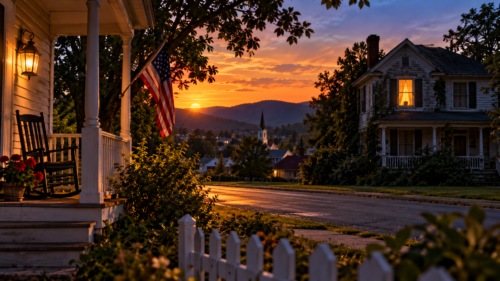
Every evening, shortly before sunset, a yellow light appeared in the second-floor window of the old Henderson house at the end of Maple Street. It remained there until sunrise, regardless of the weather, the season, or whether anyone appeared to be home.
Most people had stopped noticing it.
But not Daniel Foster.
Daniel had noticed that light every time he’d returned to Mill Creek, which wasn’t often. He had left the little mountain town at eighteen, determined to make something of himself somewhere that didn’t close its sidewalks at six o’clock.
Now, at sixty-two, he was coming back for good.
Or at least until he could sell his mother’s house.
He pulled his pickup into the driveway just as the evening shadows began stretching across the neighborhood. The house looked smaller than he remembered. The porch sagged a little, and weeds had pushed their way through the cracks in the sidewalk.
His mother had died three weeks earlier.
Daniel had been in Denver when the call came.
He’d promised himself he’d visit her that summer. Then summer became fall, and fall became Christmas, and Christmas became another year.
There was always something.
Now there wasn’t.
He sat in the truck for several minutes, looking at the house where he’d grown up.
Then he glanced across the street.
The upstairs light in the Henderson house came on.
Right on schedule.
“Well, I’ll be damned,” he whispered.
The following morning, Daniel walked downtown for breakfast.
Mill Creek hadn’t changed much. The hardware store was gone, replaced by a thrift shop. The old movie theater was boarded up, and the bank had become a real estate office.
But Miller’s Diner was still there.
So was Ruth Miller.
“Daniel Foster!” she exclaimed when he stepped through the door. “Well, look what the wind blew in.”
Ruth was nearly eighty, with silver hair and the same sharp blue eyes Daniel remembered from childhood.
“Hello, Ruth.”
She came around the counter and hugged him.
“I’m sorry about your mother, honey. She was a good woman.”
“Thank you.”
“Sit down. Coffee?”
“Please.”
She poured him a cup and settled into the booth across from him.
“You staying long?”
“Long enough to clean out the house and put it on the market.”
Ruth looked disappointed but didn’t say anything.
Daniel stirred his coffee.
“Can I ask you something?”
“Of course.”
“Who’s living in the Henderson house these days?”
Ruth stopped smiling.
“Nobody.”
“Nobody?”
“Not for years.”
“Then who’s turning on that upstairs light?”
Ruth looked toward the window.
“Some things around here are better left alone.”
Daniel laughed.
“Come on, Ruth. You can’t seriously believe the place is haunted.”
“I didn’t say it was haunted.”
“Then what?”
She folded her hands.
“Do you remember Emily Henderson?”
Daniel’s smile faded.
Of course he remembered Emily.
There were some people a man could forget, and others who stayed with him no matter how many years passed.
Emily had been sixteen when Daniel was seventeen.
She had dark brown hair, a crooked smile, and a habit of laughing at things nobody else found funny.
They’d spent one summer together.
One perfect summer.
And then he’d left.
“Yeah,” he said quietly. “I remember Emily.”
Ruth watched him for a moment.
“Her mother died about fifteen years ago. Her father passed before that. The house has been empty ever since.”
“What happened to Emily?”
“She left town.”
“Where’d she go?”
“Don’t know.”
Daniel looked down at his coffee.
Ruth reached across the table and touched his hand.
“Your mother always said you should’ve come home more often.”
He nodded.
“I know.”
That afternoon, Daniel found the letters.
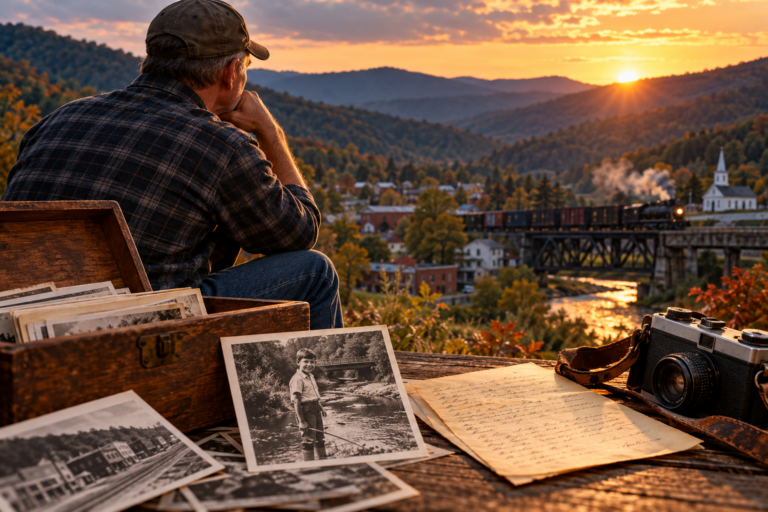
They were tucked inside a shoebox at the back of his mother’s bedroom closet, beneath a stack of Christmas cards and old photographs.
Most were ordinary family correspondence.
Then he found an envelope addressed to him.
The handwriting was unmistakable.
Daniel Foster.
No return address.
He opened it carefully.
Dear Danny,
I don’t know if you’ll ever read this. Your mother said she’d make sure you got it, but I suppose that’s up to you.
I waited for you at the station that night.
I know you had dreams, and I never wanted to stand in the way of them. But I wish you’d told me goodbye.
You said you’d come back before the leaves fell.
I believed you.
Love, Emily.
Daniel sat down on the edge of the bed.
He remembered the night he’d left.
His father had driven him to the bus station in the next town. Daniel had been angry, impatient, desperate to get away from everything he considered small and ordinary.
He hadn’t told Emily he was leaving early.
He’d convinced himself it would be easier that way.
For both of them.
He’d been wrong.
There were four more letters.
The second was written a month later.
The third, six months after that.
The fourth was dated the following summer.
And the fifth—
Daniel stared at the date.
It had been written twenty-three years ago.
Dear Danny,
I saw your picture in the newspaper. Your company must be doing well. You looked happy.
I’m glad.
I still live in Mill Creek, though I suppose you wouldn’t recognize much of my life now.
Sometimes I wonder whether people really forget the ones they loved, or whether they simply learn to live without them.
I hope you’ve had a wonderful life.
Emily.
Daniel read the letter three times.
Then he put it down and stared out the bedroom window.
Across the street, the Henderson house stood silent beneath the afternoon sun.
The next evening, Daniel crossed Maple Street.
The old Henderson property was overgrown. The front steps were cracked, and one shutter hung crookedly beside an upstairs window.
He knocked.
No answer.
He tried the door.
Locked.
Walking around the side of the house, he noticed something strange.
The electric meter was gone.
He stood looking at the empty mounting bracket.
No electricity.
Yet every night, without fail, the upstairs window glowed.
He returned home just before sunset and pulled a chair onto his mother’s porch.
At 6:42, the light came on.
Daniel stood.
He crossed the street again, this time carrying a flashlight.
There was a narrow path through the weeds along the side of the Henderson house. He followed it toward the backyard.
That’s when he saw the extension cord.
It ran from the rear of the house, through the weeds, beneath the fence, and into the neighboring yard.
Daniel followed it.
The cord disappeared through a basement window of a small white house.
He knocked on the back door.
A man in his seventies answered.
“Can I help you?”
“I’m Daniel Foster. I grew up across the street.”
The man studied him.
“Foster?”
“Yes, sir.”
“Margaret’s boy?”
“That’s right.”
The old man nodded slowly.
“I’m Walter Briggs. Moved here about twenty years ago.”
Daniel pointed toward the Henderson house.
“Can you tell me why there’s an extension cord running into that place?”
Walter looked past him.
Then he sighed.
“Come on inside.”
Walter poured two glasses of iced tea and led Daniel into the kitchen.
“Emily Henderson asked me to do that,” he explained.
Daniel leaned forward.
“You know Emily?”
“Knew her. Fine woman.”
“Where is she?”
Walter hesitated.
“She passed away four years ago.”
The words struck Daniel harder than he expected.
He looked away.
“Was she married?”
“No.”
“Children?”
Walter shook his head.
“Not that I know of.”
Daniel sat silently.
Walter continued.
“Emily moved back into that house after her mother died. Took care of the place as best she could. She worked at the library for years.”
“And the light?”
Walter smiled faintly.
“Funny story, that.”
He leaned back in his chair.
“Emily told me that when she was a girl, somebody once promised her he’d always know where home was, because she’d leave a light burning in the upstairs window.”
Daniel closed his eyes.
He remembered.
It had been a warm August night, and they’d been sitting on the Henderson porch.
He’d been talking about leaving town.
Emily had asked how he’d find his way back.
“Easy,” he’d told her. “Just leave a light on for me.”
She’d laughed.
“Then I will.”
He hadn’t thought about those words in forty-five years.
Walter cleared his throat.
“She kept that light on for years. After she got sick, she asked if I’d make sure it stayed burning. I figured it was the least I could do.”
“Why?”
Walter shrugged.
“Because it mattered to her.”
Daniel stared at the table.
“Did she ever tell you who she was waiting for?”
“No. Never did.”
The old man looked at him carefully.
“But I reckon I know now.”
Daniel didn’t sleep that night.
He sat in his mother’s living room, surrounded by old photographs and boxes of things that had once seemed important.
He thought about his career.
The promotions.
The houses.
The vacations.
The marriage that had ended after twenty years.
He’d spent his entire adult life chasing something just beyond his reach.
And somehow, in all that running, he’d forgotten the people who had loved him before he’d become anyone worth knowing.
He picked up the fifth letter again.
I hope you’ve had a wonderful life.
Had he?
He’d certainly had a successful one.
But he wasn’t sure those were the same thing.
Three days later, Daniel visited the cemetery.
Emily Henderson’s grave was near the top of a small hill overlooking Mill Creek.
Her headstone was simple.
EMILY ANNE HENDERSON
1965–2022
She loved deeply and asked for little.
Daniel stood before it for a long time.
“I’m sorry, Em,” he finally whispered.
The wind moved softly through the trees.
“I should’ve come back.”
He knelt and placed a small bouquet of flowers beside the stone.
“I should’ve at least said goodbye.”
There was no answer, of course.
Only the sound of leaves stirring along the hillside.
But somehow, saying the words made him feel a little less burdened.
A week later, Ruth Miller found Daniel sitting in his usual booth at the diner.
“Thought you’d be gone by now,” she said.
“Changed my plans.”
“Oh?”
“I’m keeping the house.”
Ruth smiled.
“Well, that’s good news.”
“Needs some work.”
“Most things worth keeping do.”
Daniel laughed.
“You’re getting philosophical in your old age.”
“I’ve always been philosophical. You were just too young to listen.”
She refilled his coffee.
“What’s changed your mind?”
Daniel looked out the window toward Maple Street.
“I think I’ve spent enough of my life running away from home.”
Ruth nodded.
“Your mother would’ve liked hearing that.”
He smiled sadly.
“I know.”
Winter came early that year.
By Thanksgiving, the mountains surrounding Mill Creek were covered with snow, and the streets were decorated with Christmas lights.
Daniel had repaired the porch, painted the kitchen, and begun restoring the house he’d once been so eager to escape.
He volunteered at the library two afternoons a week.
He started attending Sunday dinners at Ruth’s.
And occasionally, he visited Emily’s grave.
Not because he believed she could hear him.
But because there were things he wished he’d told her.
On Christmas Eve, Daniel walked across Maple Street and knocked on Walter Briggs’s door.
Walter answered wearing a red sweater.
“Merry Christmas, Daniel.”
“Merry Christmas.”
Daniel handed him a small wrapped package.
“What’s this?”
“Just a little thank-you.”
Inside was a new automatic timer and a box of warm yellow lightbulbs.
Walter chuckled.
“Keeping the tradition going?”
“If you don’t mind.”
“Not at all.”
Daniel glanced toward the Henderson house.
“Actually, I’ve been thinking.”
“About what?”
“Maybe I could buy the place. Fix it up.”
Walter raised an eyebrow.
“That’s a lot of work.”
“I’ve got time.”
“What would you do with it?”
Daniel smiled.
“Emily loved books. Maybe I could turn it into a little reading room. Somewhere kids could come after school.”
Walter’s expression softened.
“She would’ve liked that.”
“I hope so.”
The following spring, the old Henderson house opened its doors for the first time in years.
Daniel called it Emily’s Place.
There were bookshelves in the front room, comfortable chairs beside the windows, and a long wooden table where children could do homework.
Ruth donated a coffee pot.
Walter built a bookshelf.
The local librarian brought over boxes of donated books.
And on the wall near the entrance, Daniel hung a framed photograph of a young woman with dark brown hair and a crooked smile.
Beneath it was a small brass plaque.
In memory of Emily Anne Henderson, who believed that everyone deserved a place to come home to.
On opening day, a little girl approached Daniel as he stood near the doorway.
“Mister?”
“Yes, sweetheart?”
“Why do you leave that light on upstairs?”
Daniel looked toward the staircase.
For a moment, he could almost hear Emily laughing on that long-ago summer evening.
He knelt beside the little girl.
“Because,” he said, “sometimes people get lost.”
She frowned.
“Like in the woods?”
“Sometimes.”
“Then what?”
Daniel smiled.
“Well, if somebody leaves a light on, maybe they’ll find their way home.”
The little girl considered this.
Then she nodded.
“That’s a good idea.”
Daniel watched her hurry back toward the bookshelves.
Outside, the sun was beginning to set.
And upstairs, in the window overlooking Maple Street, a small yellow light flickered on.
It would burn through the night.
Not because anyone was still waiting.
But because, at long last, someone had come home.
THE END